Car Carriers and Tilt Trailers: Beavertail vs Hydraulic Tilt vs Low-Profile
4 min read
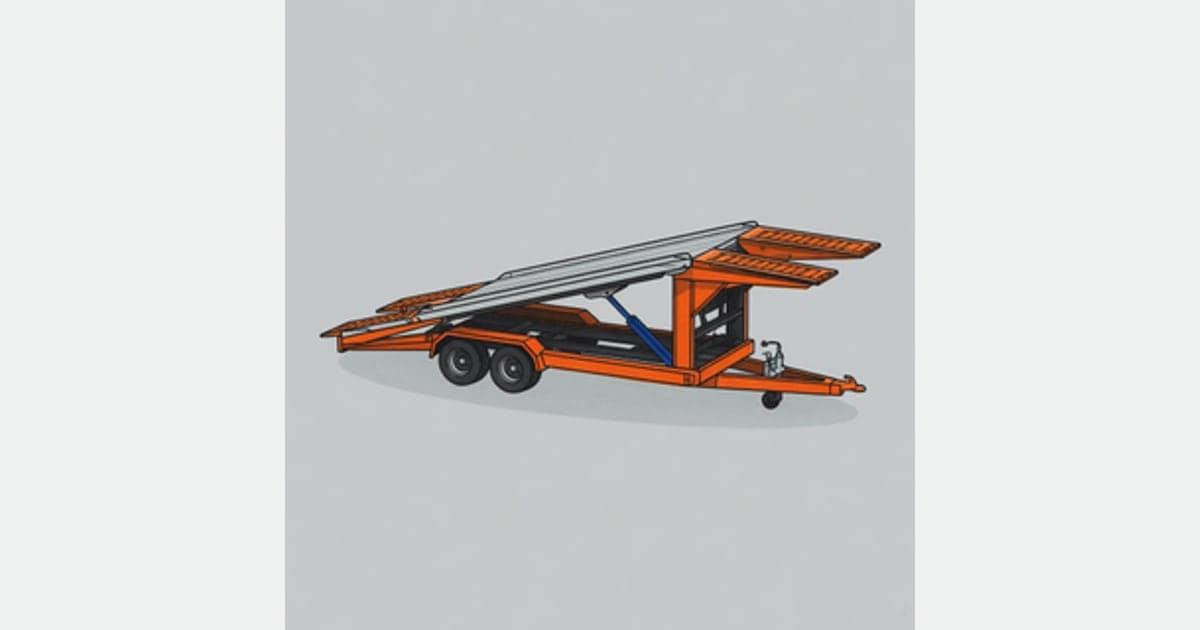
A car carrier's whole job is getting a vehicle on and off the deck without drama, and there are three genuinely different mechanical approaches to that problem on the Australian market. Picking the wrong one for your vehicle means either a car that won't clear the ramp angle or a trailer that's more mechanism than you need.
Beavertail
A beavertail trailer has a fixed rear section of deck angled down toward the ground, tapering the loading angle so a low-clearance vehicle can drive on without the front bumper or splitter catching, the way it would on a flat deck with a separate steep ramp. It's a simple, mechanically robust design with no hydraulics or moving deck to maintain, which is why it's remained a mainstay of the car-trailer market for decades; one long-running Victorian manufacturer has built more than 1,500 units on this layout alone.
Beavertail trailers suit most road cars, utes and 4WDs well. Where they start to struggle is genuinely low vehicles, a track car with a front splitter or a lowered street car, where even the tapered angle isn't shallow enough.
Hydraulic tilt
A hydraulic tilt trailer's entire deck pivots on a hydraulic ram, tilting the whole loading surface down to near-ground level rather than tapering just the rear section. Because the whole deck lowers, the effective loading angle is shallower than a beavertail can achieve, which makes it the better choice for genuinely low-clearance vehicles. It also generally loads and unloads faster once you're used to it, since you're not walking a vehicle up a taper.
The trade-off is complexity: a hydraulic ram, pump and pivot mechanism is more to maintain and more to go wrong than a fixed deck, and tilt trailers typically cost more new than an equivalent beavertail. Tilt car trailers on the Australian market commonly run from around 2000kg up to 4500kg ATM depending on deck length and duty rating, so check the specific model's ATM against your vehicle's weight with margin for fuel and gear, not just its kerb weight.
Low-profile / lowering deck
The third approach skips ramps and tapers altogether: the deck itself lowers down close to the ground on its own mechanism, then the vehicle drives on essentially flat. This is a specialist design aimed squarely at very low vehicles, race cars and show cars where even a hydraulic tilt's shallow angle is still too steep. These trailers tend to be lighter overall (some purpose-built race-car versions run notably lower tare weight than a general-purpose car trailer of similar deck length) precisely because they're built for one job rather than general duty.
If you're carrying a normal road vehicle, a low-profile trailer is usually more mechanism and more cost than you need. If you're carrying something with 60mm of ground clearance, it may be the only design that actually works.
Single vs tandem axle, and what rides alongside car carriers
Most light single-vehicle car trailers sit on a single axle in the lighter ATM tiers. Once you're carrying a heavier vehicle, want the stability margin, or want to run close to a 3500kg ATM ceiling, tandem-axle car carriers are the standard step up, following the same single-vs-tandem logic covered in our box trailer guide: better stability and load spread, more tare weight and maintenance in return.
The same tilt-deck and beavertail platforms that carry cars also underpin a related family of trailers worth knowing about if you're shopping this category: motorbike and dirt-bike trailers (open, ramped decks sized for one or several bikes), enclosed motorbike trailers (a fully enclosed box body for security and weather protection), and ATV/UTV/quad and buggy/side-by-side trailers, commonly in the 1400-1600kg ATM tier with a full-suspension, load-rated deck rather than a light box-trailer chassis. Plant tilt trailers, built on the same tilting principle but rated and decked for mini excavators or skid steers rather than a car, are covered in our upcoming plant trailer coverage.
Brakes and towing capacity on a car carrier
Because a loaded car carrier routinely sits well above the 2000kg GTM line once you add the vehicle it's carrying, full electric or hydraulic brakes with a breakaway system are standard on anything but the very lightest carriers. Don't assume, though; check the specific trailer's brake fitment against our brake requirements guide, especially on an older or private-sale unit where brakes may have been neglected.
Just as importantly, work out the combined ATM (trailer tare plus the vehicle you're carrying, not just the trailer's own tare) against your tow vehicle's braked towing capacity and towball rating before you buy. Our ATM vs GTM guide and the tow capacity calculator both work from the trailer's ATM and ball weight, so run the numbers with a realistic loaded weight, not the trailer's tare alone.
Buying used
Beyond the standard PPSR and compliance plate check, a hydraulic tilt trailer specifically needs its ram, pump and hoses checked for leaks and smooth operation, since a tilt mechanism that binds or drops unevenly is both a safety issue and a real repair cost. On a beavertail, check the taper section and rear crossmember for stress cracking, since it takes the brunt of loading impact over the trailer's life. On any car carrier, check the tie-down points and winch (if fitted) are solid, not just cosmetically present.
Browse current car carrier and tilt trailer listings, or list one for sale or hire if you're selling.